

Egg Freezing: What It Is, How It Works, and How to Prepare Your Body
Written by: Dr. Susan Fox, DACM, L.Ac., FABORM
Credentials: Fertility and Women’s Health Expert, Founder of HealthYouniversity
Updated: May 2026
Medical disclaimer: This article is educational and does not replace medical advice from your physician, OB-GYN, reproductive endocrinologist, urologist, midwife, oncologist, or licensed healthcare provider.
Key Takeaways
Egg freezing, also called oocyte cryopreservation, is a fertility preservation procedure where mature eggs are retrieved from the ovaries, frozen, and stored for possible future use.
Egg freezing can preserve reproductive options, but it does not guarantee a future pregnancy or live birth.
Age at freezing and the number of mature eggs frozen are two of the most important factors that influence future success. ASRM notes that age at vitrification and number of oocytes are predictors of future success in medically indicated fertility preservation.
Egg freezing may be used for planned fertility preservation, medical fertility preservation, before certain ovarian surgeries, or before gender-affirming treatment.
A strong egg-freezing plan should include medical testing, realistic counseling, cost review, future-use planning, nutrition, lifestyle support, and emotional support.
Health Youniversity’s whole-body fertility model supports egg freezing preparation through four pillars: Nutrition, Circulation, Lifestyle, and Emotional Support.
Quick Answer
Egg freezing is a fertility preservation process where mature eggs are collected from the ovaries, frozen, and stored for possible future use. It may help people preserve reproductive options before age-related fertility decline, medical treatment, ovarian surgery, or life circumstances that delay pregnancy. Egg freezing can create more options, but it is not a guarantee; future success depends on age at freezing, number of mature eggs frozen, egg survival after thaw, fertilization, embryo development, uterine health, and pregnancy factors.
Introduction
Egg freezing can feel empowering, practical, emotional, and overwhelming all at once.
For some people, it offers more time. For others, it is a medically urgent step before chemotherapy, radiation, surgery, or treatment that may affect fertility. And for many, it brings up a deeper question: “What can I do now to protect my future options?”
Here’s what matters: egg freezing is not an insurance policy.
It is a medical process that may preserve reproductive possibility. It works best when you understand what the procedure can do, what it cannot promise, what questions to ask, and how to prepare your body and mind before the cycle begins.
In this guide, you’ll learn what egg freezing is, how it works, who it may help, what to expect, how much it may cost, how to prepare, and what mistakes to avoid before starting.
What Is Egg Freezing?
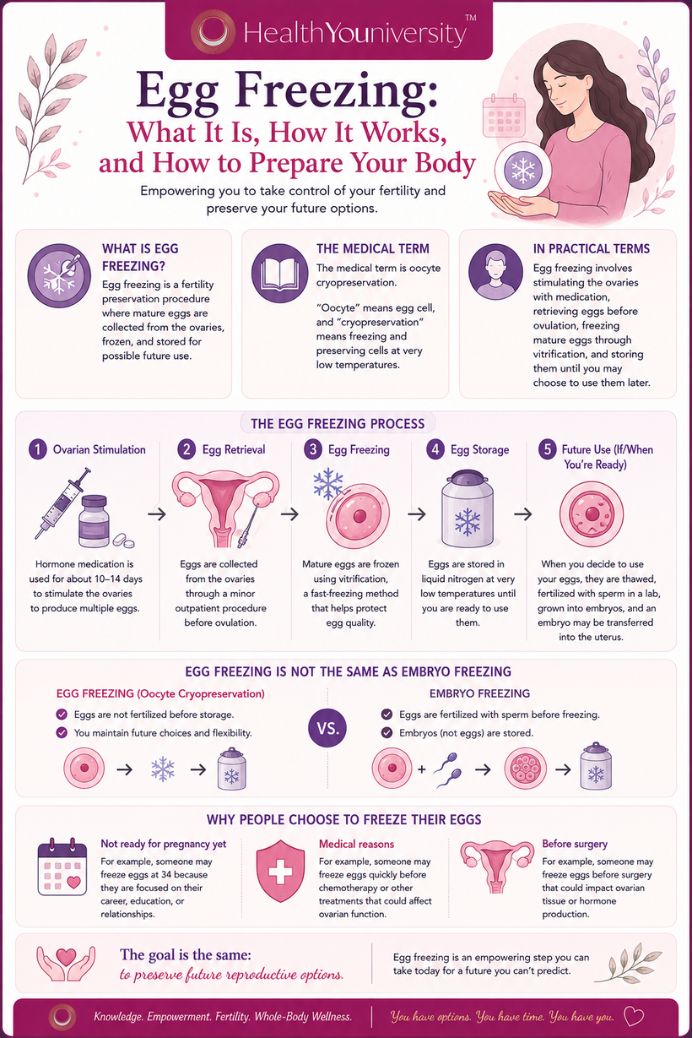
Egg freezing is a fertility preservation procedure where mature eggs are collected from the ovaries, frozen, and stored for possible future use.
The medical term is oocyte cryopreservation. “Oocyte” means egg cell, and “cryopreservation” means freezing and preserving cells at very low temperatures.
In practical terms, egg freezing involves stimulating the ovaries with medication, retrieving eggs before ovulation, freezing mature eggs through vitrification, and storing them until you may choose to use them later.
Egg freezing is not the same as embryo freezing. With egg freezing, the eggs are not fertilized before storage. If you decide to use them later, they are thawed, fertilized with sperm in a lab, grown into embryos, and then an embryo may be transferred into the uterus.
For example, someone may freeze eggs at 34 because they are not ready for pregnancy yet. Another person may freeze eggs quickly before chemotherapy. Another may freeze eggs before surgery that could affect ovarian tissue.
The goal is the same: to preserve future reproductive options.
Why Is Egg Freezing Important?
Egg freezing matters because fertility changes over time.
Egg quantity and egg quality generally decline with age, and for some people, medical treatment or surgery can also affect future fertility. Egg freezing may give someone a chance to preserve eggs at the age and health status they are when retrieved.
ASRM states that planned oocyte cryopreservation is ethically permissible and may help individuals avoid future infertility, while emphasizing that people should be informed about uncertainties regarding effectiveness and long-term effects.
For medical fertility preservation, ASRM recommends prompt counseling for patients preparing to undergo treatments that may pose a risk to fertility, and states that mature oocyte cryopreservation is an established fertility preservation technique for postpubertal females.
Here’s the nuance.
Egg freezing can create options. It cannot create certainty.
Many people think egg freezing “pauses fertility.” The better way to understand it is this: egg freezing preserves eggs from a specific point in time, but future pregnancy still depends on many steps after thaw.
How Does Egg Freezing Work?
Egg freezing works by stimulating the ovaries to mature multiple eggs, retrieving those eggs, and freezing the mature eggs for possible future use.
Step
What Happens
Why It Matters
Consultation
You meet with a fertility specialist
Reviews goals, age, medical history, ovarian reserve, and expectations
Testing
Bloodwork and ultrasound assess ovarian reserve
Helps estimate how your ovaries may respond
Ovarian stimulation
Injectable hormones help multiple follicles grow
Aims to mature more than one egg in a cycle
Monitoring
Ultrasounds and bloodwork track follicle growth
Helps your clinic adjust medications and time retrieval
Trigger shot
A medication helps eggs reach final maturity
Prepares eggs for retrieval
Egg retrieval
Eggs are collected during a short outpatient procedure
Retrieves eggs before ovulation occurs
Vitrification
Mature eggs are rapidly frozen
Helps preserve eggs for future use
Storage
Eggs remain in frozen storage
Allows possible future use through IVF
Cleveland Clinic describes egg freezing as a process that includes testing, hormone injections, egg retrieval, and vitrification. It also notes that hormone injections can cause PMS-like symptoms and that risks may include ovarian hyperstimulation syndrome and anesthesia-related risks.
What Happens When You Use Frozen Eggs Later?
Using frozen eggs later usually requires IVF.
The process may include:
Eggs are thawed.
Surviving eggs are fertilized with sperm, often using ICSI.
Fertilized eggs are monitored as embryos.
Some embryos may continue developing.
An embryo may be transferred into the uterus.
Pregnancy testing follows.
Pregnancy must continue to live birth.
This is why egg freezing should be explained as a process of probabilities, not a guarantee.
A frozen egg must pass through several stages before it can become a baby.
Egg Freezing Success: What Affects Future Outcomes?
There is no single number that guarantees a baby.
Future success depends on several factors:
Factor
Age at freezing
Number of mature eggs frozen
Ovarian reserve
Egg survival after thaw
Fertilization
Embryo development
Embryo chromosomal status
Uterine health
Pregnancy age and health
Clinic experience
Why It Matters
Younger eggs generally have a higher chance of producing chromosomally normal embryos
More mature eggs usually create more future opportunities
Helps estimate how many eggs may be retrieved in a cycle
Not all frozen eggs survive thawing
Not all thawed eggs fertilize
Not all fertilized eggs become transferable embryos
Chromosomal health affects implantation and miscarriage risk
The uterus still matters when it is time for transfer
Carrying pregnancy later may involve age-related health considerations
Lab technique and clinic-specific outcomes matter
ASRM specifically recommends that patients considering planned oocyte cryopreservation be counseled about efficacy, safety, costs, benefits, and risks, including clinic-specific outcomes when available.
CDC also notes that ART success rates vary by age, infertility diagnosis, prior pregnancy history, and procedures used, and that average success rates may not reflect an individual’s actual chance of success.
Who Should Consider Egg Freezing?
Egg freezing may be worth discussing if you want to preserve future fertility options or if a medical treatment may affect your ovaries.
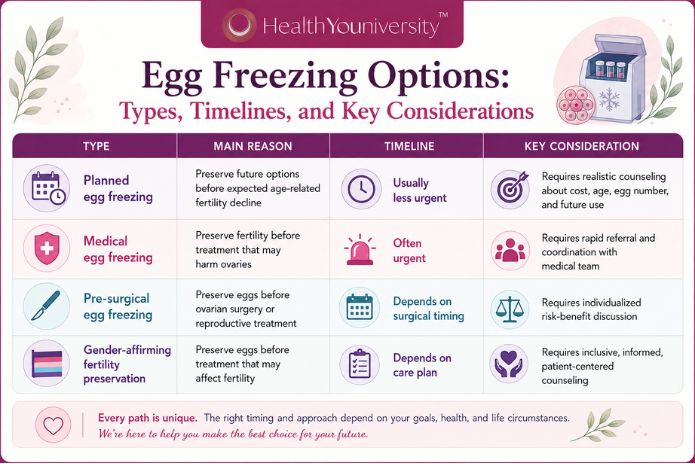
1. Planned Fertility Preservation
Planned fertility preservation is when someone freezes eggs because they are not ready to try for pregnancy now but may want the option later.
This may apply if you:
Do not currently have a partner
Are not ready for pregnancy
Want more time before family-building
Are focused on career, education, finances, health, or caregiving
Want reproductive options before age-related fertility decline becomes more significant
ASRM refers to this as planned oocyte cryopreservation and says it may serve legitimate interests in reproductive autonomy, while also emphasizing uncertainty and the need for informed consent.
2. Medical Fertility Preservation
Medical fertility preservation is when someone freezes eggs because a medical condition or treatment may harm fertility.
This may apply before:
Chemotherapy
Radiation
Gonadotoxic therapy
Gonadectomy
Some autoimmune treatments
Certain ovarian surgeries
Cancer treatment
Treatment for conditions that may increase risk of premature ovarian insufficiency
ASRM states that systemic therapy, radiation therapy, and surgery for children, adolescents, and adults of reproductive age can harm future fertility and that patients facing treatments that may impair reproductive function deserve prompt fertility preservation counseling.
3. Before Certain Reproductive or Gynecologic Procedures
Some people consider egg freezing before procedures that could affect ovarian reserve.
This may include surgery for:
Ovarian cysts
Endometriomas
Ovarian tumors
Conditions affecting ovarian tissue
A reproductive endocrinologist can help determine whether egg freezing should be considered before surgery.
4. Before Gender-Affirming Treatment
Some transgender men and gender-diverse people may consider egg freezing before gender-affirming medical or surgical treatment that may affect future fertility.
ASRM includes transgender men among those for whom planned oocyte cryopreservation may preserve reproductive options.
Planned Egg Freezing vs. Medical Egg Freezing
What Is the Best Age to Freeze Eggs?
The short answer: earlier eggs are generally younger eggs, but the best timing depends on your goals, ovarian reserve, health, finances, and likelihood of using the eggs later.
Age matters because egg quality generally declines over time.
But timing is personal.
Freezing eggs very early may mean you never use them. Waiting too long may mean fewer eggs are retrieved or more cycles are needed.
A practical way to think about it:
Age Range
General Consideration
20s
Egg quality may be stronger, but many people may never need or use frozen eggs
Early 30s
Often a common time to explore options if pregnancy may be delayed
Mid-to-late 30s
Still possible, but more eggs or more cycles may be needed
40+
May be possible, but expected egg number and success rates are often lower
SART’s 2023 outcome tables show that mean oocytes per retrieval decline by age group in non-donor cycles, with fewer average oocytes retrieved in older age groups.
This does not mean a specific birthday makes egg freezing “too late.”
It means the conversation should be individualized and honest.
How Many Eggs Should You Freeze?
There is no guaranteed number of eggs that ensures a future baby.
The number to freeze depends on:
Age at freezing
Ovarian reserve
Desired number of future children
Whether eggs survive thaw
Whether eggs fertilize
Whether embryos develop
Embryo chromosomal health
Sperm source
Uterine health
Clinic-specific lab performance
Future pregnancy health
Many people need more than one cycle to freeze the number of mature eggs recommended for their goals.
The better question is not, “How many eggs did I get?”
The better question is, “What does this number mean for someone my age, my ovarian reserve, and my future family goals?”
What Should You Expect During an Egg Freezing Cycle?
An egg freezing cycle can be physically manageable for many people, but it is still a medical process.
You may experience:
Daily hormone injections
Bloodwork
Transvaginal ultrasounds
Medication changes
Bloating
Mood changes
Pelvic heaviness
Fatigue
Activity restrictions
A trigger shot
Egg retrieval under anesthesia or sedation
Recovery after retrieval
A final report on retrieved, mature, and frozen eggs
Cleveland Clinic notes that risks can include hormone-related symptoms, ovarian hyperstimulation syndrome, and anesthesia risks.
The emotional side matters too.
Egg freezing can bring relief, pressure, grief, hope, uncertainty, financial stress, and disappointment if the results are not what you expected.
This is not just about your ovaries.
It is also about your nervous system, your future, and the meaning behind the decision.
How Long Does Egg Freezing Take?
Once medications begin, the stimulation and retrieval portion of an egg freezing cycle often takes around 8–14 days, although the full process can take longer because of consultation, testing, insurance review, medication ordering, scheduling, and recovery. The current Health Youniversity egg freezing article already highlights this 8–14 day stimulation-to-retrieval window.
A realistic timeline may look like this:
Stage
Common Timeline
Consultation and testing
A few days to several weeks
Medication ordering and cycle planning
Several days to a few weeks
Ovarian stimulation
About 8–14 days
Egg retrieval
One procedure day
Recovery
Usually a few days, depending on symptoms
Storage
Ongoing until eggs are used, donated, discarded, or transferred according to consent forms
Your timeline may be shorter or longer depending on your medical urgency, clinic availability, cycle timing, medication response, and whether you are freezing eggs for planned or medical reasons.
How Much Does Egg Freezing Cost?
Egg freezing can be expensive, and the total cost varies by clinic, location, medication needs, insurance coverage, number of cycles, storage fees, and future use costs.
Costs may include:
Consultation
Ovarian reserve testing
Bloodwork
Ultrasounds
Injectable medications
Monitoring visits
Egg retrieval
Anesthesia
Lab fees
Vitrification/freezing
Annual storage
Future thawing
Fertilization
Embryo culture
Embryo transfer
Cleveland Clinic estimates egg freezing often costs around $10,000–$12,000 before annual storage and future use costs.
Before starting, ask your clinic for a written cost breakdown.
Ask:
Are medications included?
Is anesthesia included?
Are monitoring visits included?
What is the annual storage fee?
What happens if I need another cycle?
What is the future cost to thaw, fertilize, and transfer?
Does my insurance cover planned egg freezing or only medical fertility preservation?
Egg Freezing vs. Embryo Freezing: What Is the Difference?
Egg freezing stores unfertilized eggs.
Embryo freezing stores eggs that have already been fertilized with sperm and developed into embryos.
Option
What Is Frozen
Best For
Key Consideration
Egg freezing
Unfertilized eggs
People who do not want to choose sperm now
More flexibility for future sperm choice
Embryo freezing
Fertilized embryos
People with a partner or donor sperm selected
More information about fertilization and embryo development
Both
Eggs and embryos
People who want multiple future options
Higher cost and more decisions
Cleveland Clinic explains that embryo cryopreservation freezes fertilized eggs, while egg freezing preserves unfertilized eggs.
Neither option is universally better.
Egg freezing may offer more flexibility because you do not need to choose sperm now. Embryo freezing may give more information earlier because you can see fertilization and embryo development.
Your best option depends on your situation, values, legal considerations, sperm source, and family-building goals.
How to Prepare for Egg Freezing: Step-by-Step
Step 1: Clarify Why You Are Freezing Eggs
Start by naming your reason.
Are you freezing eggs because of age, relationship timing, career timing, medical treatment, surgery, gender-affirming care, endometriosis, low ovarian reserve, or uncertainty about future pregnancy?
This matters because your timeline and urgency may change depending on the reason.
Practical tip: Write down your primary reason and your ideal future family size before your consultation.
Step 2: Schedule a Fertility Consultation
Meet with a reproductive endocrinologist or fertility clinic.
Ask about:
Your age-related expectations
Your ovarian reserve
AMH
Antral follicle count
FSH and estradiol, if recommended
Expected egg yield
Whether more than one cycle may be needed
Risks based on your medical history
Cost and insurance coverage
What happens when you use the eggs later
ASRM recommends clinic-specific counseling whenever possible because outcomes can vary by clinic, age, and egg number.
Practical tip: Ask your clinic to explain your likely egg yield in plain language, not just numbers.
Step 3: Review Your Medical History and Medications
Bring a complete list of:
Diagnoses
Medications
Supplements
Hormonal birth control
Surgeries
Cancer history, if relevant
Endometriosis or ovarian cyst history
PCOS history
Thyroid concerns
Blood clotting history
Prior pregnancies or miscarriages
Family history
Do not stop medications on your own.
Ask your provider what should continue, pause, or change before stimulation.
Step 4: Build a Whole-Body Preparation Plan
Egg freezing is a medical procedure, but your body is still the starting point.
Health Youniversity’s Preconception Plan emphasizes whole-body reproductive support through Nutrition, Circulation, Lifestyle, and Emotional Support.
Focus on:
Protein-rich meals
Hydration
Healthy fats
Fiber-rich carbohydrates
Colorful fruits and vegetables
Sleep rhythm
Gentle movement
Reduced alcohol
Avoiding smoking and vaping
Lowering avoidable toxin exposure
Stress support
Provider-approved supplements only
This does not guarantee more eggs.
It helps support the body going into treatment.
Step 5: Prepare for the Monitoring Schedule
Egg freezing requires multiple appointments over a short period.
You may need:
Morning bloodwork
Transvaginal ultrasounds
Medication adjustments
Trigger shot timing
Retrieval scheduling
Someone to drive you home after retrieval
Plan ahead with work, childcare, transportation, and support.
Practical tip: Before stimulation begins, ask your clinic which appointment windows are most common and how quickly medication instructions may change.
Step 6: Prepare for Retrieval Recovery
Egg retrieval is usually outpatient, but recovery still matters.
Ask your clinic:
How long should I rest?
What symptoms are expected?
What symptoms are urgent?
When can I return to exercise?
What should I eat and drink after retrieval?
What should I do if bloating worsens?
Who do I call after hours?
Call your clinic promptly if you experience severe pain, rapid weight gain, shortness of breath, heavy bleeding, fever, or significantly reduced urination.
Step 7: Prepare Emotionally
Egg freezing can feel like a practical decision, but it often touches deeper emotions.
You may feel:
Empowered
Sad
Pressured
Relieved
Anxious
Hopeful
Overwhelmed
Disappointed by results
Unsure what the numbers mean
Health Youniversity includes guided imagery, stress reduction, qigong, and individualized support as part of fertility preparation.
Practical tip: Choose one trusted person who can support you through appointments, retrieval day, and the results conversation.
Step 8: Ask What the Results Mean
After retrieval, ask your clinic:
How many eggs were retrieved?
How many eggs were mature?
How many eggs were frozen?
Is that number expected for my age and ovarian reserve?
Would another cycle be recommended?
What are realistic expectations if I use these eggs later?
What happens if I never use them?
What are my storage and consent options?
That question turns numbers into a plan.
The Health Youniversity Four-Pillar Egg Freezing Preparation Framework
Health Youniversity’s fertility model is built around four pillars: Nutrition, Circulation, Lifestyle, and Emotional Support.
1. Nutrition
Nutrition supports hormone balance, egg health, blood sugar, inflammation, and energy.
This does not mean chasing a perfect “egg quality diet.”
It means nourishing your body consistently with protein, healthy fats, fiber, colorful plants, minerals, and hydration.
The CDC recommends 400 micrograms of folic acid daily for all women capable of becoming pregnant. While egg freezing itself does not create an immediate pregnancy, many people preparing for fertility preservation also benefit from preconception nutrition counseling depending on their timeline and goals.
2. Circulation
Circulation focuses on supporting blood flow to the ovaries and reproductive organs.
This may include:
Walking
Gentle stretching
Qigong
Breath-led movement
Acupoint stimulation
Avoiding prolonged sedentary patterns
During stimulation, follow your clinic’s exercise guidance. High-impact exercise, twisting, jumping, or intense abdominal work may be restricted because enlarged ovaries can increase discomfort or risk.
3. Lifestyle
Lifestyle includes the daily choices that shape whole-body health.
Focus on:
Sleep rhythm
Alcohol reduction
Smoking and vaping cessation
Caffeine moderation
Toxin reduction
Product swaps
Medication and supplement review
Stress patterns
The Health Youniversity Preconception Plan includes practical lifestyle routines, including hydration, reducing BPA, phthalates, and synthetic fragrances, and supporting sleep hygiene.
4. Emotional Support
Egg freezing can be emotionally vulnerable.
The stimulation cycle may be short, but the meaning of the decision can be long-lasting.
Support may include:
Therapy
Fertility coaching
Guided imagery
Breathwork
Meditation
Acupuncture or acupoint stimulation
Journaling
A trusted friend or partner
Clear boundaries around who knows about the process
This is not just “mindset.”
It is nervous system support during a decision that can hold grief, hope, and uncertainty at the same time.
Egg Freezing Preparation Checklist
Egg freezing works by stimulating the ovaries to mature multiple eggs, retrieving those eggs, and freezing the mature eggs for possible future use.
Preparation Area
What to Do
Why It Matters
Medical consultation
Meet with a reproductive endocrinologist
Clarifies whether egg freezing fits your goals
Ovarian reserve testing
Ask about AMH, AFC, FSH, estradiol
Helps estimate possible response
Medication review
Share prescriptions, herbs, and supplements
Helps avoid interactions or risks
Cost review
Request written pricing
Prevents surprise expenses
Future-use planning
Ask what happens when eggs are thawed
Clarifies the full IVF pathway later
Nutrition
Build regular meals with protein, healthy fats, fiber, plants
Supports whole-body readiness
Movement
Use gentle movement before stimulation
Supports circulation and stress regulation
Toxin reduction
Reduce smoking, vaping, heavy alcohol, and avoidable exposures
Supports reproductive and whole-body health
Emotional support
Choose your support system before the cycle
Helps with uncertainty and results
Consent review
Read storage and disposition forms carefully
Clarifies what happens to unused eggs
Questions to Ask Before Freezing Your Eggs
Bring these questions to your clinic:
What are my ovarian reserve results?
What egg yield do you expect for someone my age?
How many mature eggs would you recommend for my goals?
How many cycles might I realistically need?
What are your clinic-specific thaw survival, fertilization, embryo development, and live birth outcomes using frozen eggs?
What medication protocol do you recommend and why?
What side effects should I expect?
What are the risks of OHSS for me?
What symptoms should make me call the clinic?
What is included in the cost estimate?
What are the annual storage fees?
What happens if I move clinics later?
What happens if I do not use the eggs?
What are my disposition options?
What would the future IVF process look like if I use the eggs?
The better question is not only, “Can I freeze my eggs?”
The better question is, “What is the most realistic plan for my age, my ovarian reserve, my finances, and my future family goals?”
Common Mistakes to Avoid With Egg Freezing
1. Thinking Egg Freezing Guarantees a Baby
Egg freezing gives you a possible future option. It does not guarantee pregnancy or live birth.
ASRM warns that there is a risk of misplaced confidence in the effectiveness of planned oocyte cryopreservation.
Better approach: Ask your clinic for age-specific and clinic-specific counseling.
2. Waiting Too Long to Ask Questions
Some people wait until they are ready for pregnancy before exploring fertility preservation.
Better approach: If you think pregnancy may be delayed, schedule a consultation earlier so you understand your options.
3. Focusing Only on AMH
AMH can help estimate ovarian response, but it does not tell the whole fertility story.
Better approach: Interpret AMH with age, antral follicle count, cycle history, medical history, and goals.
4. Not Asking About Future Use
Freezing eggs is only the first step.
Later, you may need thawing, fertilization, embryo culture, genetic testing if recommended, embryo transfer, and pregnancy care.
Better approach: Ask what the full future process may involve.
5. Forgetting About Storage and Consent Decisions
You will need to decide what happens to your eggs if you do not use them, stop paying storage fees, become incapacitated, die, or want to donate them.
Better approach: Read consent forms carefully and ask questions before signing.
6. Ignoring the Emotional Weight
Egg freezing can bring up grief, hope, pressure, fear, and disappointment.
Better approach: Build emotional support before the cycle starts, not only after a difficult result.
7. Comparing Your Egg Number to Someone Else’s
Egg yield varies widely.
Age, ovarian reserve, medication response, diagnosis, and cycle protocol all matter.
Better approach: Ask your provider what your result means for you.
8. Not Reviewing Supplements With Your Clinic
Some supplements may interact with medications, affect bleeding risk, or be inappropriate during stimulation or retrieval.
Better approach: Give your clinic a complete list of medications, supplements, herbs, and over-the-counter products.
Tools and Resources That Can Help With Egg Freezing
Fertility Consultation Checklist
Use this to ask about ovarian reserve, age-specific expectations, cycle timeline, risks, costs, future use, and clinic-specific outcomes.
Lab and Ultrasound Tracker
Track AMH, FSH, estradiol, antral follicle count, follicle growth, medication doses, eggs retrieved, mature eggs, and eggs frozen.
Medication Calendar
Daily injections and trigger timing matter. Use a written schedule, phone alarms, and clinic instructions.
Cost Breakdown Worksheet
Ask for every cost category in writing, including medications, monitoring, retrieval, anesthesia, freezing, storage, and future thaw/fertilization/transfer costs.
Emotional Support Plan
Choose your support before the cycle begins. This may include therapy, coaching, guided imagery, breathwork, a trusted friend, or a partner.
Health Youniversity Preconception Plan
Health Youniversity’s Preconception Plan supports people preparing for egg freezing, IVF, or natural conception with nutrition, acupoint stimulation, guided imagery, qigong, recipes, sample menus, shopping lists, and individualized support.
FAQs
What is egg freezing?
Egg freezing is a fertility preservation procedure where mature eggs are retrieved from the ovaries, frozen, and stored for possible future use. The medical term is oocyte cryopreservation.
Does egg freezing guarantee pregnancy?
No. Egg freezing does not guarantee pregnancy or live birth. Some eggs may not survive thaw, fertilize, become embryos, implant, or lead to a healthy birth.
How does egg freezing work?
Egg freezing works by using hormone medications to stimulate multiple follicles, retrieving eggs from the ovaries, freezing mature eggs through vitrification, and storing them for possible future use. If you use them later, they are thawed, fertilized with sperm, grown into embryos, and potentially transferred into the uterus.
How long does egg freezing take?
The stimulation and retrieval portion often takes about 8–14 days once medication begins, but the full timeline can be longer because of consultation, testing, medication ordering, scheduling, and recovery.
Is egg freezing safe?
Egg freezing is widely used, but it is still a medical procedure. Risks may include hormone-related symptoms, bloating, ovarian hyperstimulation syndrome, anesthesia risks, bleeding, infection, or injury during retrieval. Cleveland Clinic notes that hormone injections can cause PMS-like symptoms and that OHSS and anesthesia risks are possible.
What is the best age to freeze eggs?
There is no perfect age for everyone. Younger eggs are generally more likely to produce healthy embryos, but the right timing depends on your goals, ovarian reserve, health, finances, and likelihood of using the eggs later.
How many eggs should I freeze?
There is no guaranteed number. The number depends on your age, ovarian reserve, desired number of children, egg survival after thaw, fertilization, embryo development, embryo chromosomal health, and future pregnancy factors. Ask your clinic for individualized counseling.
Is egg freezing better than embryo freezing?
Neither option is universally better. Egg freezing offers more flexibility because you do not need to choose sperm now. Embryo freezing may provide more information earlier because you can see fertilization and embryo development. Your best option depends on your situation and values.
What happens when I want to use my frozen eggs?
The eggs are thawed, fertilized with sperm in a lab, grown into embryos, and then an embryo may be transferred into the uterus. This means using frozen eggs later usually requires IVF.
Can I prepare my body before egg freezing?
Yes. You can support your body with medical testing, nutrition, hydration, sleep, gentle movement, toxin reduction, emotional support, and a clear plan with your fertility team. This does not guarantee a specific egg number, but it can help you enter the process with more support and clarity.
Conclusion
Egg freezing is not a guarantee.
It is a possibility.
It can help preserve future reproductive options, but it works best when people receive clear counseling, realistic expectations, transparent costs, clinic-specific outcome information, and whole-body support before and during the process.
If you are considering egg freezing, the most important next step is not to panic or rush. It is to get accurate information, understand your ovarian reserve, ask the right questions, and prepare your body and mind for the process.
If you are preparing for egg freezing, IVF, or natural conception, Health Youniversity’s Preconception Plan can help you support your whole-body fertility foundation with nutrition, circulation, lifestyle guidance, and emotional care.
Learn About the Preconception Plan, take the Take the Fertility Quiz or schedule a Fertility Assessment Call with Health Youniversity

About The Author
Dr. Susan Fox
DACM, L.Ac., FABORM
Fertility and Women’s Health Expert, Founder of Health Youniversity
Dr. Susan Fox has 24 years of experience in women’s health and fertility support, with expertise in fertility coaching, IVF preparation, natural conception, IUI, PCOS, endometriosis, diminished ovarian reserve, and unexplained infertility. She is a Licensed Acupuncturist in California, a Health and Wellness Coach, and a Fellow of the Acupuncture & TCM Board of Reproductive Medicine.
FEATURED IN:



© 2026 Your Fertile Health LLC. All rights reserved. The content of this website, including but not limited to text, graphics, images, and any other material contained on this website,
is for informational purposes only and is the property of Your Fertile Health LLC. Unauthorized use, distribution, or reproduction is strictly prohibited.