

Infertility: What It Is, Why It Happens, and What to Do Next
Written by: Dr. Susan Fox, DACM, L.Ac., FABORM
Credentials: Fertility and Women’s Health Expert, Founder of HealthYouniversity
Updated: May 2026
Medical disclaimer: This article is educational and does not replace medical advice from your physician, OB-GYN, reproductive endocrinologist, urologist, midwife, oncologist, or licensed healthcare provider.
Key Takeaways
Infertility is commonly defined as not being able to get pregnant after 12 months or more of regular, unprotected intercourse. WHO defines infertility as a disease of the male or female reproductive system.
Infertility can involve female factors, male factors, both partners, or unexplained causes.
Fertility evaluation is usually recommended after 12 months of trying if the female partner is under 35, after 6 months if she is 35 or older, and sooner if she is over 40 or has a known fertility-related condition.
A complete fertility evaluation should include ovulation, uterine and fallopian tube health, and semen analysis when sperm is part of the equation.
Infertility care is not only about getting pregnant. It is also about preparing the body, mind, and support system for conception, pregnancy, and a healthy baby.
Health Youniversity’s whole-body fertility approach centers on nutrition, circulation, lifestyle, and emotional support.
Quick Answer
Infertility is the inability to achieve pregnancy after 12 months or more of regular, unprotected intercourse, or sooner when age, medical history, irregular cycles, recurrent pregnancy loss, or known fertility conditions suggest earlier evaluation is needed. It can be caused by ovulation problems, sperm issues, fallopian tube problems, uterine factors, endometriosis, age-related fertility decline, or unexplained factors. The first step is to seek a fertility evaluation that looks at both partners when sperm is involved, while also supporting whole-body fertility through nutrition, circulation, lifestyle, and emotional care.
Introduction
Infertility can feel confusing, isolating, and deeply personal.
For many people, it begins quietly. A few months of trying become a year. Ovulation tests, cycle tracking apps, supplements, fertility diets, lab results, and well-meaning advice start to pile up. At some point, the question changes from “When will this happen?” to “Is something wrong?”
Here’s what matters: infertility is not a personal failure.
It is a medical condition that deserves clear information, timely evaluation, and compassionate support.
In this guide, you’ll learn what infertility means, why it happens, when to seek help, what tests may be involved, what treatment options exist, and how to support your whole body while you move through the fertility journey.
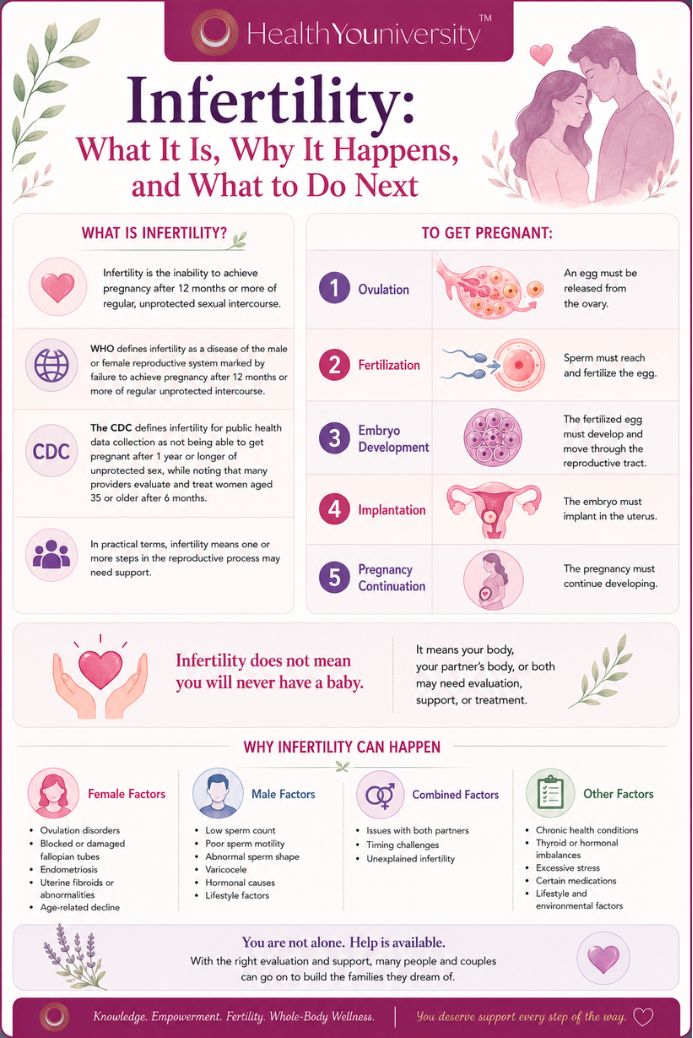
What Is Infertility?
Infertility is the inability to achieve pregnancy after 12 months or more of regular, unprotected sexual intercourse.
WHO defines infertility as a disease of the male or female reproductive system marked by failure to achieve pregnancy after 12 months or more of regular unprotected intercourse.
The CDC defines infertility for public health data collection as not being able to get pregnant after 1 year or longer of unprotected sex, while noting that many providers evaluate and treat women aged 35 or older after 6 months.
In practical terms, infertility means one or more steps in the reproductive process may need support.
To get pregnant:
An egg must be released from the ovary.
Sperm must reach and fertilize the egg.
The fertilized egg must develop and move through the reproductive tract.
The embryo must implant in the uterus.
The pregnancy must continue developing.
Infertility does not mean you will never have a baby.
It means your body, your partner’s body, or both may need evaluation, support, or treatment.
What Infertility Is Not
Infertility is often misunderstood.
Infertility is not:
A personal failure
Always permanent
Always caused by the female partner
Always solved by “just relaxing”
Always fixed by supplements or lifestyle changes
Always a sign that IVF is the only option
Always explained by one lab result
Always visible from the outside
Many people think infertility means the body is broken.
The better way to understand it is this: infertility means the reproductive process needs more information, more support, or a different strategy.
Why Is Infertility Important?
Infertility matters because it affects the body, the heart, the relationship, the finances, and the future someone is trying to build.
WHO estimates that about 1 in 6 people of reproductive age worldwide experience infertility in their lifetime.
In the United States, the CDC reports that 1 in 5 married women ages 15–49 with no prior births are unable to get pregnant after 1 year of trying, and about 1 in 4 have difficulty getting pregnant or carrying a pregnancy to term.
For many people, the challenge is not only getting pregnant.
It is the grief of another negative test. The pressure of time. The cost of treatment. The uncertainty of unexplained results. The emotional exhaustion of trying to stay hopeful while feeling like your body is not cooperating.
Health Youniversity’s approach emphasizes that fertility support is not only about getting pregnant. It is about preparing the body to receive and nurture new life in the healthiest, most sustainable way possible.
How Does Infertility Happen?
Infertility can happen when one or more parts of the reproductive process are disrupted.
Category
What It Means
Examples
Ovulatory factors
The egg is not released regularly or predictably
PCOS, thyroid imbalance, hypothalamic amenorrhea, perimenopause
Tubal factors
The fallopian tubes are blocked or damaged
Prior infection, pelvic inflammatory disease, surgery, endometriosis
Uterine factors
The uterus or lining may affect implantation or pregnancy
Fibroids, polyps, uterine septum, scarring
Male factors
Sperm count, movement, shape, or ejaculation may be affected
Low sperm count, low motility, abnormal morphology, varicocele
Endometriosis or pelvic factors
Inflammation or adhesions may interfere with fertility
Endometriosis, pelvic adhesions, ovarian endometriomas
Combined factors
More than one factor is involved
Irregular ovulation plus low sperm motility
Unexplained infertility
Standard testing does not clearly identify a cause
Normal ovulation, tubes, uterus, and semen analysis, but no pregnancy
WHO notes that infertility may be caused by factors in the male reproductive system, female reproductive system, both, or sometimes no identifiable cause.
The better question is not, “Whose fault is this?”
The better question is, “Which part of the reproductive process needs more information or support?”
What Are the Main Causes of Infertility?
1. Ovulation Problems
Ovulation problems happen when the body does not release an egg regularly.
This may show up as:
Irregular periods
Absent periods
Long cycles
Short cycles
Unpredictable bleeding
No clear ovulation signs
ASRM notes that ovulatory dysfunction is identified in about 15% of infertile couples and accounts for up to 40% of infertility in women.
Common contributors may include:
PCOS
Thyroid dysfunction
Hyperprolactinemia
Significant weight changes
Excessive exercise
Perimenopause
Stress-related hypothalamic disruption
Certain medications or medical conditions
Regular cycles between 21–35 days often suggest ovulation, but irregular cycles deserve evaluation.
2. Age-Related Fertility Decline
Age is one of the most important fertility factors, especially for egg quality and ovarian reserve.
ASRM states that female fertility declines with age and that female age is the single most important predictor of fecundity.
This does not mean pregnancy is impossible after 35 or 40.
It means time becomes more clinically important, and earlier evaluation may be appropriate.
3. Fallopian Tube Problems
Fallopian tubes matter because this is where sperm and egg often meet.
If one or both tubes are blocked or damaged, sperm may not reach the egg, or the fertilized egg may not travel properly toward the uterus.
Possible causes include:
Pelvic inflammatory disease
Prior sexually transmitted infections
Endometriosis
Previous ectopic pregnancy
Abdominal or pelvic surgery
Scar tissue or adhesions
ASRM recommends HSG or SHG when tubal patency needs to be evaluated.
4. Uterine Factors
The uterus matters because implantation and pregnancy development happen there.
Uterine factors may include:
Fibroids
Polyps
Uterine septum
Scar tissue
Chronic inflammation
Congenital uterine differences
Endometrial cavity abnormalities
Not every fibroid or uterine finding causes infertility.
The impact depends on size, location, symptoms, and whether the uterine cavity is affected. A professional can help determine what matters and what does not.
5. Male Factor Infertility
Male factor infertility is common and should not be treated as an afterthought.
AUA/ASRM guidance states that both male and female partners should undergo concurrent assessment during the initial infertility evaluation, and the initial male evaluation should include reproductive history and one or more semen analyses.
Male factor concerns may include:
Low sperm count
Low sperm motility
Abnormal morphology
Ejaculation problems
Varicocele
Hormonal conditions
Prior infections
Heat exposure
Smoking, alcohol, marijuana, or other substances
Certain medications or anabolic steroid use
This is where many couples lose time.
Fertility evaluation should not focus only on the person carrying the pregnancy.
6. Endometriosis
Endometriosis can affect fertility through inflammation, adhesions, altered pelvic anatomy, ovarian endometriomas, or changes in the reproductive environment.
Some people with endometriosis have obvious symptoms, such as painful periods, pain with sex, bowel symptoms, or pelvic pain.
Others have few symptoms.
ASRM notes that peritoneal factors such as endometriosis and pelvic adhesions may cause or contribute to infertility.
7. Unexplained Infertility
Unexplained infertility means standard testing has not identified a clear reason pregnancy has not happened.
This can feel especially frustrating because “unexplained” can sound like “nothing is wrong.”
That is not always true.
It may mean the issue is more subtle, harder to measure, or not captured by the first round of testing.
A structured plan can still help.
Female Factor vs. Male Factor vs. Unexplained Infertility
Type
What It Means
What to Ask
Female factor infertility
Ovulation, fallopian tubes, uterus, ovarian reserve, hormones, or pelvic factors may be involved
“Are we checking ovulation, tubes, uterus, ovarian reserve, and relevant hormones?”
Male factor infertility
Sperm count, motility, morphology, ejaculation, hormones, or anatomy may be involved
“Has semen analysis been done early, and should a male reproductive specialist review it?”
Combined factor infertility
More than one factor is present
“How do these factors interact, and what should we address first?”
Unexplained infertility
Standard testing has not identified a clear cause
“What has been ruled out, and what are the next reasonable options?”
When Should You See a Fertility Specialist?
The short answer: do not wait too long.
ASRM recommends infertility evaluation and indicated treatment after 12 months of trying for women under 35, after 6 months for women 35 or older, and more immediate evaluation for women over 40. Evaluation should also begin without delay when there is a known condition associated with infertility.
Situation
When to Seek Care
Under 35, regular cycles, no known risk factors
After 12 months of trying
Age 35 or older
After 6 months of trying
Over 40
Consider more immediate evaluation
Irregular or absent periods
Seek care sooner
Known or suspected PCOS
Seek care sooner
Known or suspected endometriosis
Seek care sooner
Recurrent miscarriage
Seek care sooner
Prior ectopic pregnancy
Seek care sooner
Known male factor concerns
Seek care sooner
History of pelvic infection or tubal disease
Seek care sooner
Prior chemotherapy, radiation, or ovarian surgery
Seek care sooner
This is not about panic.
It is about protecting your time and getting the right information sooner.
How Is Infertility Diagnosed?
Infertility is diagnosed through a structured evaluation of ovulation, reproductive anatomy, sperm health, medical history, and timing.
ASRM states that infertility evaluation should be systematic, expeditious, and cost-effective, beginning with the least invasive methods for detecting common causes.
Evaluation Area
What It Looks At
Common Tests or Questions
Ovulation
Whether eggs are being released
Menstrual history, LH kits, progesterone, cycle tracking
Ovarian reserve
Egg quantity indicators, not guaranteed egg quality
AMH, FSH, estradiol, antral follicle count
Uterus
Cavity and implantation environment
Ultrasound, saline sonogram, hysteroscopy when indicated
Fallopian tubes
Whether tubes appear open
HSG or SHG
Sperm
Count, motility, morphology, volume
Semen analysis
Hormones
Thyroid, prolactin, metabolic health
TSH, prolactin, A1c, and others if indicated
Medical history
Health factors that may affect fertility
Surgeries, infections, medications, family history
Health Youniversity’s Preconception Plan also emphasizes reviewing reproductive hormones, sperm analysis when relevant, nutrition, hydration, circulation, lifestyle routines, emotional support, and whole-health labs such as thyroid, vitamin D, iron, and ferritin when appropriate.
What Is the Difference Between Infertility and Subfertility?
Infertility and subfertility are often used together, but they do not always mean the exact same thing.
Infertility usually means pregnancy has not occurred after a defined period of trying, often 12 months of regular unprotected intercourse.
Subfertility means fertility may be reduced, but pregnancy may still be possible with more time, support, or treatment.
For example, someone with irregular ovulation may be subfertile because they ovulate less often. Someone with blocked fallopian tubes may need medical treatment because sperm and egg may not be able to meet.
The best approach depends on the cause.
How Is Infertility Treated?
Infertility treatment depends on the diagnosis, age, duration of trying, sperm results, tubal status, ovulation, uterine health, and personal goals.
Treatment Option
What It May Help With
Key Consideration
Lifestyle and preconception support
Whole-body readiness, pregnancy preparation, modifiable risk factors
Supportive, but not a cure for every cause
Ovulation induction
Irregular or absent ovulation
Requires provider guidance and monitoring
Timed intercourse
Mild timing or ovulation issues
Best when tubes and sperm are adequate
IUI
Mild male factor, donor sperm, unexplained infertility, timing concerns
Fertilization still happens inside the body
IVF
Tubal disease, significant male factor, endometriosis, age-related concerns, genetic testing needs, failed prior treatments
More medically intensive and expensive
Surgery
Some fibroids, polyps, adhesions, endometriosis, varicocele
Depends on diagnosis and risk-benefit analysis
Donor eggs, donor sperm, or gestational carrier
Egg, sperm, uterine, genetic, or medical limitations
Requires emotional, medical, legal, and ethical counseling
WHO notes that fertility care includes prevention, diagnosis, and treatment, not only IVF.
A good fertility plan should explain the “why” behind each recommendation.
Can Lifestyle Changes Cure Infertility?
The short answer: sometimes lifestyle changes can help, but they cannot fix every cause of infertility.
Lifestyle changes may support:
Blood sugar balance
Inflammation balance
Hormone health
Ovulation patterns
Sperm health
Sleep quality
Stress resilience
Pregnancy readiness
But lifestyle changes cannot open blocked fallopian tubes, reverse every sperm factor, erase age-related egg changes, or guarantee pregnancy.
ASRM notes that healthy lifestyle and diet should be encouraged for general health and reproductive outcomes, while also stating there is insufficient evidence that one specific diet or macronutrient pattern improves natural fertility for everyone.
The goal is not to replace medical care.
The goal is to support the body while getting the right care.
The Health Youniversity Four-Pillar Infertility Support Framework?
Health Youniversity’s fertility framework centers on four pillars: Nutrition, Circulation, Lifestyle, and Emotional Support.
1. Nutrition.
Nutrition supports hormone balance, blood sugar, inflammation, egg health, sperm health, and early pregnancy development.
This does not mean following a perfect fertility diet.
It means creating a steady foundation with protein, healthy fats, fiber-rich carbohydrates, colorful plants, hydration, and appropriate supplementation.
2. Circulation
Circulation matters because reproductive organs need nutrient-rich blood flow.
From a whole-health perspective, movement, gentle exercise, acupoint stimulation, and body-based practices may help support circulation and connection to the body.
3. Lifestyle
Lifestyle includes sleep, toxin reduction, alcohol and tobacco avoidance, stress patterns, movement, and daily routines.
ACOG notes that prepregnancy counseling should include review of medications, supplements, immunizations, nutrition, exercise, substance use, and environmental and occupational exposures.
4. Emotional Support
Infertility is more than physical.
Emotional support may include therapy, fertility coaching, breathwork, guided imagery, meditation, acupuncture, support groups, or structured mind-body care.
Support should not be treated as optional.
How to Get Started After an Infertility Diagnosis?
Step 1: Confirm Your Timeline
Start by identifying how long you have been trying.
Count the months of regular unprotected intercourse or insemination attempts. Also note cycle regularity, age, prior pregnancies, miscarriages, and known medical conditions.
This helps determine whether you should continue trying, begin basic testing, or seek specialist care now.
Practical tip: Write down the month you started trying, your average cycle length, and any cycle changes you have noticed.
Step 2: Schedule the Right Evaluation
If you meet criteria for evaluation, schedule with an OB-GYN, reproductive endocrinologist, or fertility clinic.
If sperm is part of the equation, do not wait to evaluate the sperm partner. AUA/ASRM recommends concurrent assessment of both partners and semen analysis as part of the initial male fertility evaluation.
Practical tip: Ask for semen analysis early, not after every female-factor test has been completed.
Step 3: Gather Your Health History
Prepare a simple fertility history before the appointment.
Include:
Cycle length and regularity
How long you have been trying
Ovulation tracking results
Prior pregnancies or losses
Surgeries
Pelvic infections
Painful periods
Medications and supplements
Family history
Partner health history
Lifestyle exposures
This helps your provider move faster and ask better questions.
Step 4: Ask What Each Test Is Trying to Answer
Testing should not feel like a random list.
Ask:
Are we checking ovulation?
Are we checking egg supply?
Are we checking whether tubes are open?
Are we checking the uterine cavity?
Are we checking sperm?
Are we checking thyroid, metabolic, or inflammatory factors?
What will this result change about the plan?
That question turns testing into strategy.
Step 5: Build a Whole-Body Preparation Plan
While testing is happening, start supporting your body.
Begin with:
Folic acid or prenatal support
Consistent meals
Protein and fiber
Sleep rhythm
Gentle movement
Reduced alcohol, smoking, and toxic exposures
Emotional support
Partner health support
CDC recommends that all women capable of becoming pregnant get 400 micrograms of folic acid daily to help prevent neural tube defects.
Step 6: Decide on the Next Step With Your Provider
Once testing is complete, ask your provider to explain your options.
Those may include:
Continue trying naturally for a defined period
Ovulation support
Timed intercourse
IUI
IVF
Surgery
Donor options
Additional testing
Referral to another specialist
The goal is not to rush.
The goal is to avoid drifting without a plan.
Common Mistakes to Avoid With Infertility
1. Waiting Too Long to Ask for Help
Many people wait because they hope the next cycle will be the one.
Hope matters. But so does timing.
Better approach: If you meet the evaluation timeline, or if you have known risk factors, seek support.
2. Testing Only One Partner
Infertility can involve female factors, male factors, both, or unexplained causes.
Better approach: Evaluate both partners when sperm is part of the equation.
3. Assuming Regular Periods Mean Everything Is Fine
Regular periods are helpful, but they do not rule out tubal, uterine, sperm, endometriosis, or unexplained factors.
Better approach: Use cycle information as one part of the whole picture.
4. Using Ovarian Reserve Testing as a Standalone Fertility Prediction
Ovarian reserve tests can be useful during infertility evaluation, but ASRM notes they should not be used as screening tests for women who do not meet infertility criteria.
Better approach: Interpret AMH, FSH, and antral follicle count with age, history, diagnosis, and clinical context.
5. Taking Too Many Supplements Without Guidance
More supplements do not always mean better fertility.
Some supplements can interact with medications or may not be appropriate during fertility treatment.
Better approach: Start with evidence-based basics like folic acid, then personalize based on labs and provider guidance.
6. Treating Infertility Like a Personal Failure
Infertility is a medical condition, not a character flaw.
Better approach: Get information, build support, and stop carrying the burden alone.
7. Ignoring the Emotional Toll
The emotional burden of infertility is real.
Better approach: Include emotional support early through counseling, coaching, support groups, guided imagery, meditation, or other nervous system tools.
What Should You Expect Emotionally During Infertility?
Expect infertility to affect more than your calendar.
It may affect:
Your relationship
Your friendships
Your body image
Your finances
Your work focus
Your sleep
Your faith or sense of meaning
Your ability to attend baby showers or family events
Your trust in your body
This does not mean you are weak.
It means fertility struggle can be a high-stress life experience.
Health Youniversity’s Preconception Plan includes guided imagery, stress reduction, qigong, individualized coaching, and fertility-supportive education to help people feel more supported throughout the process.
Tools and Resources That Can Help With Infertility
Fertility Timeline Tracker
Track how long you have been trying, cycle dates, ovulation signs, intercourse timing, treatments, and test results.
Lab and Imaging Organizer
Keep AMH, FSH, estradiol, progesterone, TSH, vitamin D, ferritin, semen analysis, HSG, SHG, ultrasound, and genetic testing results in one place.
Preconception Visit Checklist
Use this to prepare questions about medications, supplements, vaccines, medical conditions, prior losses, family history, and next steps.
Semen Analysis
This is a basic and important part of infertility evaluation when sperm is involved. AUA/ASRM recommends semen analysis as part of the initial male fertility evaluation.
Fertility Assessment Quiz
A quiz can help you identify whether your next step is natural conception support, infertility evaluation, IVF preparation, egg freezing preparation, or pregnancy readiness.
Whole-Health Fertility Support
Health Youniversity’s Preconception Plan includes nutrition, acupoint stimulation, guided imagery, stress reduction, qigong, recipes, and individualized support for people preparing for natural conception, IVF, or egg freezing.
FAQs
What is infertility?
Infertility is commonly defined as not achieving pregnancy after 12 months or more of regular, unprotected intercourse. WHO defines infertility as a disease of the male or female reproductive system.
How common is infertility?
Infertility is common. WHO estimates that about 1 in 6 people of reproductive age worldwide experience infertility in their lifetime. In the United States, the CDC reports that 1 in 5 married women ages 15–49 with no prior births are unable to get pregnant after 1 year of trying.
When should I see a fertility specialist?
ASRM recommends evaluation after 12 months of trying if the female partner is under 35, after 6 months if she is 35 or older, and sooner if she is over 40 or has a known fertility-related condition.
Can men contribute to infertility?
Yes. Both male and female factors can contribute to infertility. AUA/ASRM recommends concurrent assessment of both partners during initial infertility evaluation, and the male evaluation should include reproductive history and one or more semen analyses.
What tests are usually done for infertility?
Common tests may include ovulation assessment, ovarian reserve testing, ultrasound, uterine cavity evaluation, tubal evaluation with HSG or SHG, semen analysis, thyroid testing, and other labs based on history. ASRM recommends evaluating ovulatory status, reproductive tract structure and patency, and semen when appropriate.
Does infertility mean IVF is the only option?
No. Treatment depends on the cause. Some people may benefit from lifestyle support, ovulation induction, timed intercourse, IUI, surgery, IVF, donor options, or additional testing. WHO notes that fertility care includes prevention, diagnosis, and treatment.
Can lifestyle changes cure infertility?
Lifestyle changes cannot fix every cause of infertility. However, nutrition, folic acid, smoking cessation, reduced alcohol, sleep, movement, and toxin reduction can support overall reproductive health and pregnancy readiness. ASRM encourages healthy lifestyle and diet for people attempting pregnancy, while noting that no single diet has been proven to improve natural fertility for everyone.
What should I do first if I think I may be infertile?
Start by scheduling a fertility evaluation and gathering your cycle history, medical history, medication list, supplement list, and partner information. If sperm is involved, ask for semen analysis early rather than waiting until later in the process.
What is unexplained infertility?
Unexplained infertility means standard testing has not identified a clear reason pregnancy has not happened. It does not mean nothing is wrong; it may mean the issue is more subtle, harder to measure, or not captured by the first round of testing.
Is infertility always permanent?
No. Some causes of infertility are treatable, some are manageable with assisted reproductive technology, and some require a different family-building path. The right next step depends on age, diagnosis, test results, goals, and medical guidance.
Conclusion
Infertility is not just about trying harder.
It is about understanding where the reproductive process may need support, getting the right evaluation at the right time, and building a plan that honors both the medical and emotional reality of the journey.
When you understand what infertility is, what may cause it, what tests may be needed, and what options exist, you can move forward with more clarity and less self-blame.
If you are navigating infertility, preparing for IVF, considering egg freezing, or still hoping to conceive naturally, Health Youniversity’s Preconception Plan can help you support your whole health with nutrition, circulation, lifestyle guidance, and emotional care.
Take the Fertility Quiz or schedule a Fertility Assessment Call with Health Youniversity

About The Author
Dr. Susan Fox
DACM, L.Ac., FABORM
Fertility and Women’s Health Expert, Founder of Health Youniversity
Dr. Susan Fox has 24 years of experience in women’s health and fertility support, with expertise in fertility coaching, IVF preparation, natural conception, IUI, PCOS, endometriosis, diminished ovarian reserve, and unexplained infertility. She is a Licensed Acupuncturist in California, a Health and Wellness Coach, and a Fellow of the Acupuncture & TCM Board of Reproductive Medicine.
FEATURED IN:



© 2026 Your Fertile Health LLC. All rights reserved. The content of this website, including but not limited to text, graphics, images, and any other material contained on this website,
is for informational purposes only and is the property of Your Fertile Health LLC. Unauthorized use, distribution, or reproduction is strictly prohibited.