
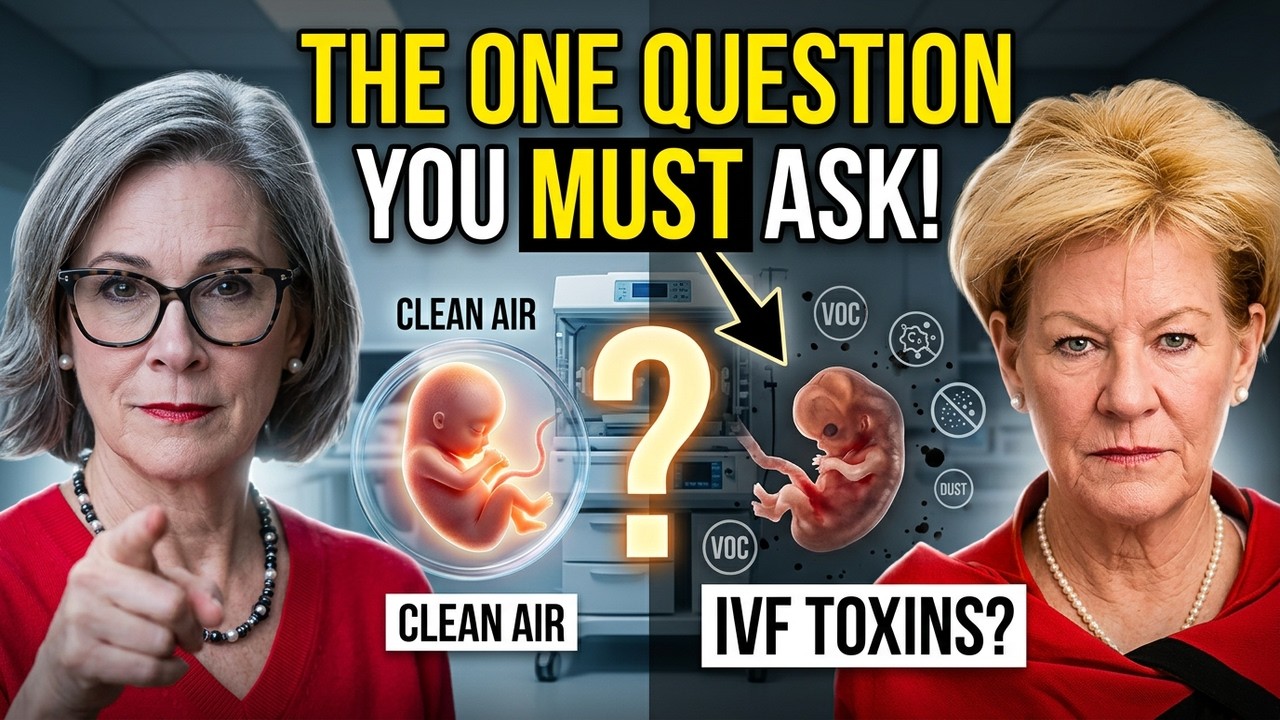
Is the Air in your IVF clinic Safe for your Embryos?
There are certain moments in medicine when you realize there is a variable you’ve never even thought to measure.
And once you see it, you cannot unsee it.
In this episode of Health Youniversity, we step into one of those moments.
In an eye opening conversation with Dr. Katie Worrilow we learn the importance and consequences of clean air in the IVF and hospital settings.
We talk constantly about environmental toxins “out there” — plastics, pesticides, endocrine disruptors. We talk about diet, stress, sleep, supplements, stimulation protocols, embryo grading. We talk about everything that happens inside the body.
But rarely do we ask:
What is the air surrounding the embryo during IVF?
Culturing Life Outside the Body
During IVF, a human embryo is cultured outside the protective environment of the body for six to seven days.
That is extraordinary when you think about it.
Every embryologist is attempting to recreate the sterile, stable, nutrient-rich environment of the fallopian tube and uterus. And they work incredibly hard to do so — clean rooms, strict gowning protocols, filtration systems, SOPs, sterile technique.
Yet one variable remained largely overlooked for decades: ambient air quality.
Not the air we worry about in wildfires or traffic pollution — but the air circulating inside the hospital or clinic itself.
The Hidden Variable
If Clinical pregnancy rates undulate , Blastocyst conversion rates drop or Implantation falters — even when embryos looked beautiful on day three, see if the timing coincide with things that seemed unrelated:
Construction outside the hospital
Parking lot resurfacing
Medevac helicopters idling
Increased ambulance traffic
All completely normal for a large medical center. All completely outside the IVF lab’s control.
But not outside its impact.
Airborne chemical pathogens — measured not in parts per million (what we can smell), but in parts per billion — were entering laboratory spaces. Invisible. Undetectable by scent. Yet measurable.
And consequential.
When Beautiful Embryos Don’t Implant
It’s a sobering discovery when:
Embryos look stunning under the microscope at day three.
Fertilization rates are normal.
Morphology is excellent.
But later — at blast conversion, at implantation, or at miscarriage — something shifted.
The effect of compromised air quality did not always show up immediately. It appeared downstream.
Because when you are caring for patients who have invested financially, emotionally, physically, and existentially into a cycle, even one preventable variable matters.
The Data That Followed
Once the importance of air quality was understood, it was not enough to hypothesize.
It had to be measured.
Large-scale studies were conducted in IVF programs. Thousands of patients were included. Environmental testing was performed before and after implementing advanced air purification technology.
The result?
Clinical pregnancy rates increased by nearly 20 percentage points in early trials. Across a broad installation base globally, the average improvement has remained approximately 15 percentage points — with corresponding increases in implantation and blast conversion rates.
Those numbers are not subtle.
And they represent more than statistics.
They represent fewer repeat retrievals.
Fewer failed cycles.
Less emotional devastation.
More siblings from frozen embryos created under protected conditions.
Why This Matters for Patients
Most patients would never think to ask about air filtration in their IVF clinic.
Why would they?
We assume hospital air is sterile. We assume the environment is controlled. We focus on hormone levels, embryo grading, and genetic testing.
But air is not a minor variable when you are culturing life outside the body.
If you are researching clinics or preparing for IVF, consider asking:
What type of air filtration system is used in the lab?
Is air quality measured and monitored?
Is filtration applied only in the embryology lab, or also in retrieval and transfer rooms?
Have you seen undulations in blast conversion or implantation rates during construction periods?
These are not adversarial questions.
They are informed ones.
The Bigger Picture: Integration, Not Blame
It is important to say this clearly: IVF providers work extraordinarily hard. They are deeply committed. They care profoundly about their patients.
The discovery of air quality impact is not a criticism of medicine. It is an evolution of it.
Just as we learned decades ago that lab incubator pH mattered…
Just as we learned embryo culture media composition mattered…
We are now learning that ambient air matters too.
Medicine progresses by refining variables.
This is one more refinement.
The Existential Weight of IVF
An IVF cycle is never “just a procedure.”
It is hope. It is investment. It is identity.
When a cycle fails, the loss is not abstract.
If even one environmental variable can be removed from the equation — if even one controllable factor can improve outcomes — that matters.
It matters to the couple sitting in the consultation room.
It matters to the woman giving herself injections at night.
It matters to the embryologist watching day five unfold.
And it should matter to insurers, benefits providers, and healthcare systems evaluating outcomes as well.
Once You Know
There are moments in medicine when you learn something that shifts how you see everything.
This is one of them.
The air surrounding an embryo during IVF is not neutral. It is either supportive or disruptive.
And now that we know that, we cannot unknow it.
If you are navigating IVF, empower yourself with information. Ask questions. Seek clarity. You deserve to understand every part of the environment in which your embryo is being cultured.
Because when we talk about optimizing fertility, we must talk about the body.
And the lab.
And even the air.
Check out all of our episodes on the following platforms:
Register for a free 28-Day Detox Masterclass to improve Your Fertile Health:
https://susanfox1.easywebinar.live/gentle-detox
Know the status of your fertility health. Take our FREE Fertility Quiz now: http://yourfertilityquiz.com/
Fulfill your dream of a family. Know your best options for a healthy pregnancy: https://www.healthyouniversity.co/programs
Boost Employee Productivity by Investing in their Fertility Health. Check out our Corporate Wellness program and know the benefits it can bring to your company: https://www.healthyouniversity.co/corporate-wellness
Dr. Kathryn C. Worrilow, Founder and CSO of LifeAire Systems, earned her postdoctorate in Reproductive Physiology and Infertility at the University of Pennsylvania School of Medicine. She served as the Scientific Director of In Vitro Fertilization Programs for over 20 years where, she studied the impact of ambient air on successful human embryogenesis and preimplantation toxicology.
This led to the development and design of the LifeAire® Systems patented air purification technology and System, Aire~IVF®. The technology offered by the LifeAire System, has been launched globally in IVF programs to protect the critical culture environment of the human embryo, and is now being used in the protection of patients, staff, and senior residents from healthcare acquired infections.
LifeAir is positioned to offer their technology to improve patient care along a continuum of care - from infants in the NICU to the surgical patient in the OR and
PACU to the ill recovering in the ICU to the elderly in senior living.
The technology and its applications have been awarded 23 patents and over 60 registered trademarks globally.
Website: https://lifeaire.com/
Medical Disclaimer:
By listening to the Health Youniversity podcast, you agree not to use this podcast as medical advice to treat any medical condition for yourself or others. Consult your healthcare provider for any medical issues you may have. This entire disclaimer also pertains to any guests or contributors to any Health Youniversity podcast.